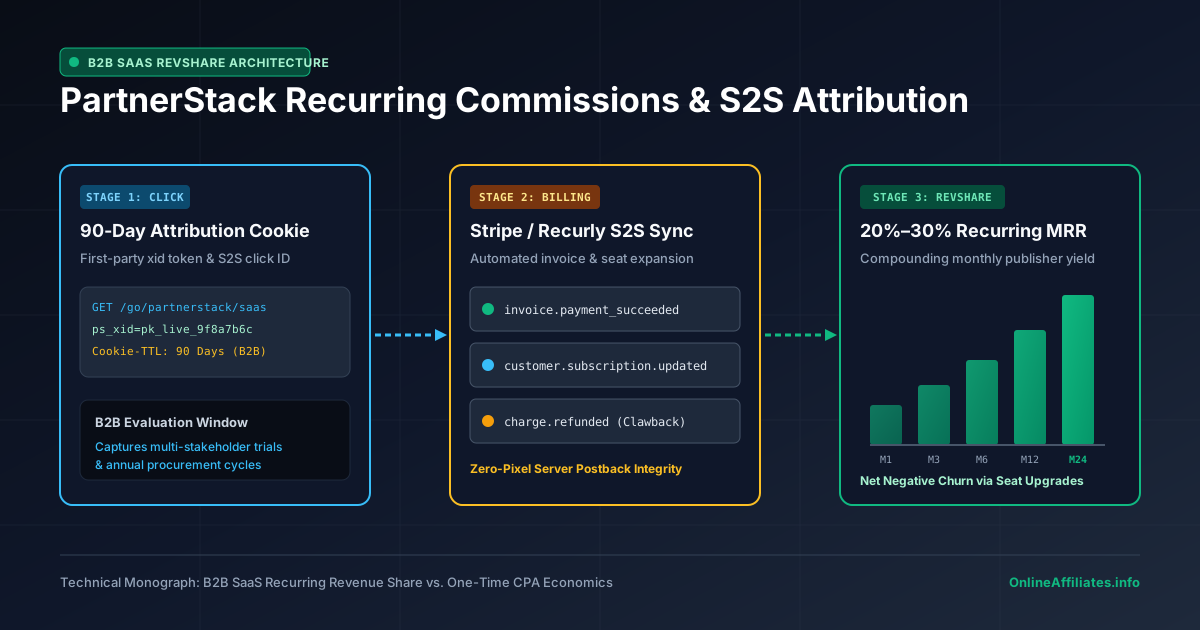
For over a decade, independent publishers treated affiliate marketing as a treadmill of one-time bounties. Whether promoting consumer electronics on a 24-hour retail cookie or driving single-event CPA signups, every month began at zero dollars in baseline revenue. B2B Software-as-a-Service (SaaS) partner ecosystems—led by platforms such as PartnerStack—fundamentally rewrote this equation by aligning publisher payouts directly with subscription billing engines like Stripe, Recurly, and Chargebee.
Why B2B SaaS Recurring Revenue Share Outperforms Retail CPA
When a business adopts a core operational platform—such as cloud hosting infrastructure, a customer relationship management (CRM) suite, an automated invoicing system, or a global payroll platform—switching costs are high. Unlike consumer apps that suffer rapid 30-day churn, B2B software subscriptions routinely retain customers for 24 to 60 months and expand in contract value as teams add seats or upgrade tiers.
In a recurring revenue-share model (typically structured between 20% and 30% of Monthly Recurring Revenue for 12 months or the lifetime of the customer account), a single referred business client compounds over time:
- Month 1 Onboarding: A mid-market company subscribes to a $150/month marketing automation tier. At a 25% revshare rate, the publisher earns $37.50 on the initial invoice.
- Month 6 Seat Expansion: The client upgrades to a $400/month plan as their team grows. Because attribution is bound to the underlying Stripe
customer_idrather than a single checkout cart, the publisher's monthly commission automatically rises to $100.00/month—a phenomenon known in SaaS economics as net negative churn. - Compounding Cohort Stacking: Referring just ten sticky B2B accounts per month builds a predictable, compounding annuity stream that persists even during seasonal traffic dips.
The Technical Mechanics of 90-Day B2B Attribution Windows
Enterprise and small-business software buyers rarely purchase on their first click. A typical B2B evaluation cycle involves reading a technical comparison guide, signing up for a 14-day free sandbox, inviting engineering or finance stakeholders to test the workflow, and waiting for corporate card approval.
To accommodate multi-week procurement cycles without losing publisher attribution to Safari Intelligent Tracking Prevention (ITP) or browser cookie purging, modern B2B partner stacks rely on a three-stage tracking architecture:
1. First-Party Link Decoration & Click ID Persistence
When a visitor clicks a tracked referral link (such as a clean domain redirect /go/partnerstack/program), the destination landing page captures the unique partner click identifier (ps_xid or gspk) and writes it into a first-party SameSite=Lax cookie alongside localStorage with a 90-day TTL.
2. Identity Stitching at Free-Trial or Freemium Signup
The moment the prospect creates a free account or requests a sandbox workspace, the frontend signup form passes the stored click identifier directly to the SaaS application's backend user creation API. From that second forward, attribution is permanently recorded in the merchant's relational database—meaning even if the user switches from a laptop to a corporate workstation three weeks later to enter their credit card, the referring publisher still receives full credit.
3. Direct Billing Engine Webhook Reconciliation
Instead of relying on fragile client-side conversion pixels on a thank-you page, the SaaS vendor's Stripe or Chargebee instance fires signed Server-to-Server (S2S) webhooks (invoice.payment_succeeded, customer.subscription.updated, and charge.refunded) directly into the partner ledger. Every monthly renewal, plan upgrade, or prorated refund is reconciled to the cent.
| Vertical Category | Representative B2B SaaS Stack | Typical Cookie Window | Standard Commission Structure | Primary Conversion Trigger |
|---|---|---|---|---|
| Cloud & Web Infrastructure | Managed VPS, Edge CDN, PaaS Clusters | 60–90 Days | 20%–30% Recurring or $50–$200 CPA | Active compute node or annual hosting plan |
| CRM & Outbound Automation | Email Deliverability, Sales Pipelines, SMS | 90 Days | 20%–25% Lifetime Recurring MRR | Paid sender tier upgrade after warmup |
| Remote Hiring & Global EOR | Contractor Payroll, Compliance, ATS | 90 Days | $150–$500 Qualified Lead + RevShare | First onboarded international contractor |
| Invoicing & Financial Ops | Automated Billing, Bookkeeping, Tax Prep | 60–90 Days | 20%–30% Recurring (12–24 Months) | Paid subscription following 30-day trial |
Handling Commission Edge Cases: Upgrades, Downgrades, and Clawbacks
A production-grade affiliate ledger must handle post-checkout subscription mutations cleanly. When evaluating or integrating B2B SaaS partner programs, publishers and platform engineers should verify four critical reconciliation rules:
- Mid-Cycle Plan Upgrades: When a referred account upgrades from a starter tier to a pro tier mid-month, the billing engine generates a prorated invoice delta. The affiliate ledger should credit the exact percentage of the incremental upgrade immediately and adjust the baseline recurring expectation for the next billing cycle.
- Plan Downgrades: When an account reduces seats effective at the next renewal date, the current month's settled commission remains intact while the projected next-cycle commission steps down proportionally.
- Partial & Full Refunds: If a customer requests a 50% service credit or a full refund within the holding period (typically 30 to 45 days before payout lock), the ledger records a proportional negative clawback entry rather than deleting the historical conversion record.
- Chargeback Disputes: If a cardholder initiates a payment dispute, the associated subscription's recurring payout stream is placed in a
disputed_holdstate until the merchant's payment processor resolves the inquiry.
High-Conversion Content Formats for B2B Software Affiliates
B2B buyers are immune to hype; they search for concrete answers to operational bottlenecks. The highest-converting editorial formats across technical and business portals consistently follow three practitioner patterns:
- Head-to-Head Architectural Benchmarks: Measuring real-world throughput, API latency, deliverability rates, or total cost of ownership across competing platforms at 1,000, 10,000, and 100,000 seats or contacts.
- Implementation & Migration Runbooks: Step-by-step guides showing exactly how to migrate data schemas, DNS records, or webhook pipelines from a legacy tool to a modern alternative without downtime.
- Interactive Cost & ROI Calculators: Allowing operations managers to input their team size or monthly transaction volume to see the exact break-even point between flat-rate and usage-based pricing tiers.